
What happens if the buyer has not agreed to pay a buyer’s agent’s fee but the seller also will not pay?
QUESTION: A friend asked me to assist him in locating and purchasing a new home, and he told me that he did not have the ability to pay a commission. We decided to use the Non-Exclusive Buyer Agency Agreement (Form 203) and agreed to a specific fee. We also marked the checkbox option in Form 203 that states that he would not be responsible for paying our firm’s fee.
After months of searching, my friend finally found a home he liked, and despite many attempts to negotiate a purchase contract with Form 220 (Buyer Agent Compensation Addendum) attached, the seller will not agree to pay any compensation to my firm. My friend has asked me to submit an offer that does not include Form 220. Am I required to do so even though my firm won’t get paid?
ANSWER: You may need to submit the offer and complete this transaction, even if your firm does not get paid.
The section of Form 203 you mention looks like this:
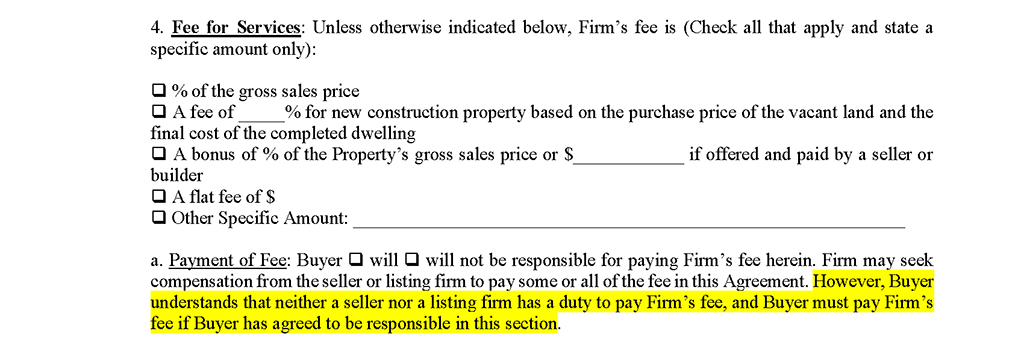
In North Carolina, the License Law and MLS rules together require that a buyer’s agent’s fee be for specific amount, not a range, and not dependent on whether or how much a seller is offering to cover a buyer’s agent’s fee. As the highlighted section makes clear, this situation was contemplated when you signed Form 203. As Form 203 later states, a buyer’s agent cannot receive compensation from any source that exceeds what is in the buyer agency agreement.
Together, all these rules mean that, in your case, you may need to proceed with agency even though you will not be paid by either the buyer or the seller. That said, you do have two options to consider.
First, the safer option and best practice is for you to submit the buyer’s offer and accept the fact that your firm will not receive compensation if the offer is accepted and the transaction closes. In the future, your firm may want to discuss and adopt policies that address this scenario while also ensuring compliance with MLS rules and the License Law.
Second, your firm may request that the buyer agree to terminate your firm’s agency agreement, but the buyer has absolutely no obligation to agree to a termination. Moreover, this option is very risky, because if you compromise the buyer’s ability to get this property by making this request, the North Carolina Real Estate Commission may consider such action a violation of the License Law.
If the buyer will not agree to terminate, then your firm will very likely not have a right to unilaterally terminate agency, and then you must follow your client’s direction and submit whatever offer your client wants to make regardless of any issues concerning compensation.
As a final note, this situation can also arise when agents insert similar, custom language into Form 201 (Exclusive Buyer Agency Agreement) that waives a buyer’s obligation to pay. The standard language in Form 201 makes clear that the buyer has an obligation to pay the firm’s fee, but sometimes agents add in custom language that waives that provision. Agents who use such custom language may find themselves in the same position addressed in this Q&A, and they should proceed with caution if they do.
Release Date: 9/10/2026
This article is intended solely for the benefit of NC REALTORS® members, who may reproduce and distribute it to other NC REALTORS® members and their clients, provided it is reproduced in its entirety without any change to its format or content, including disclaimer and copyright notice, and provided that any such reproduction is not intended for monetary gain. Any unauthorized reproduction, use or distribution is prohibited.